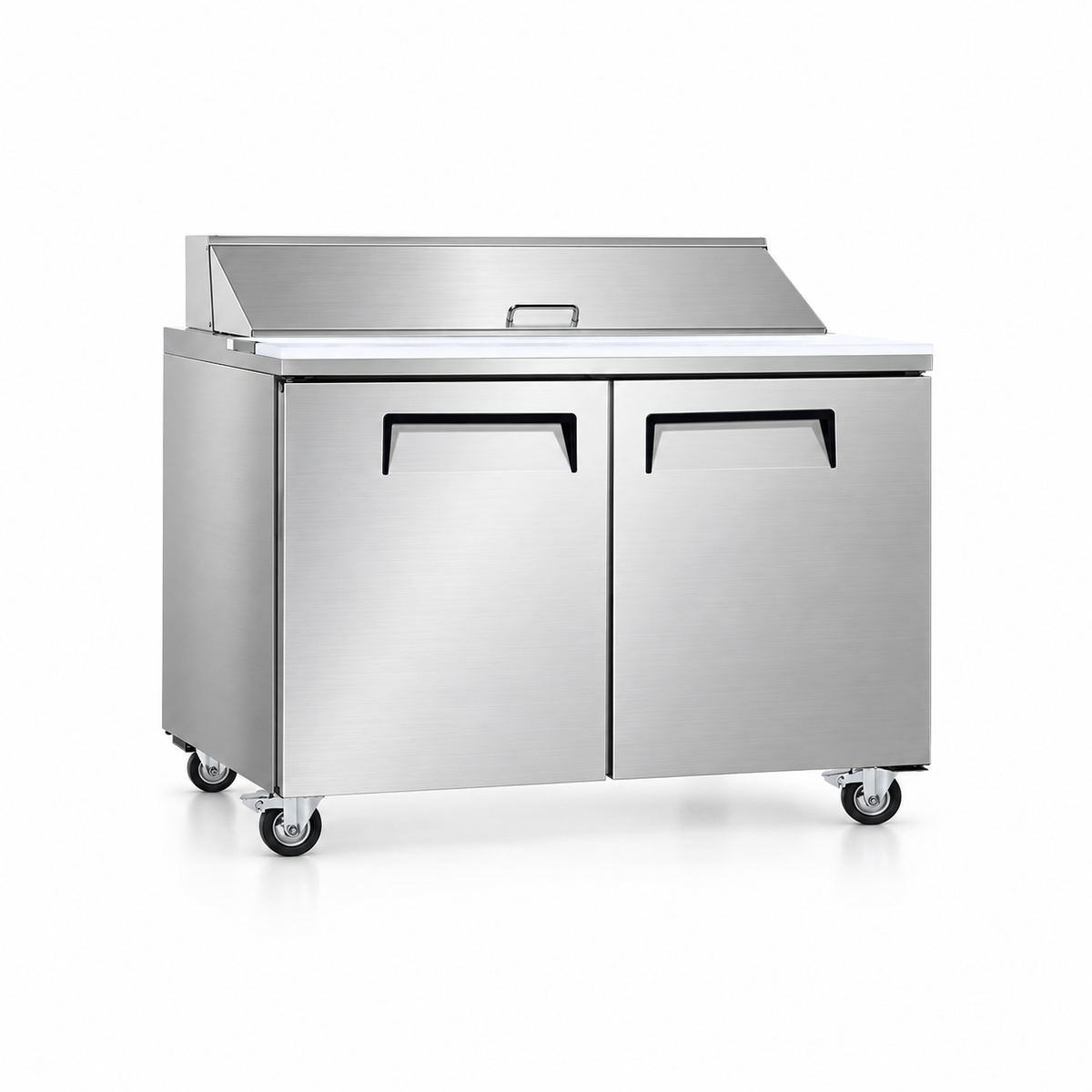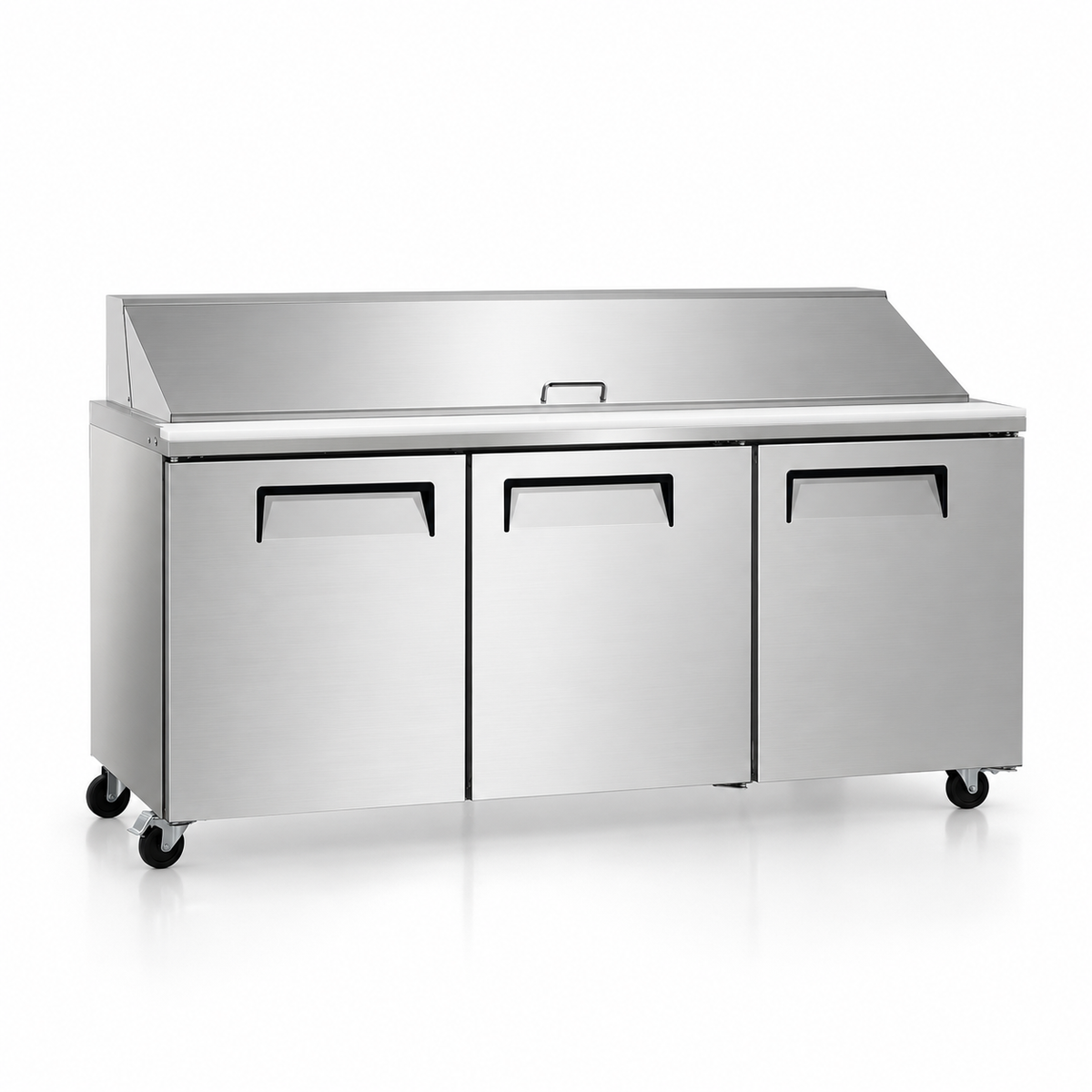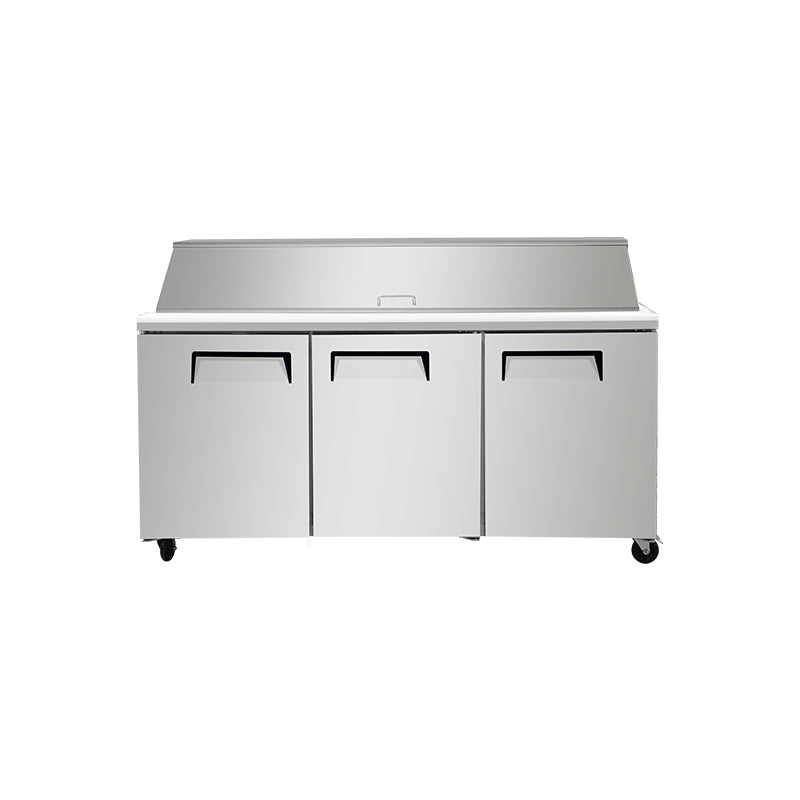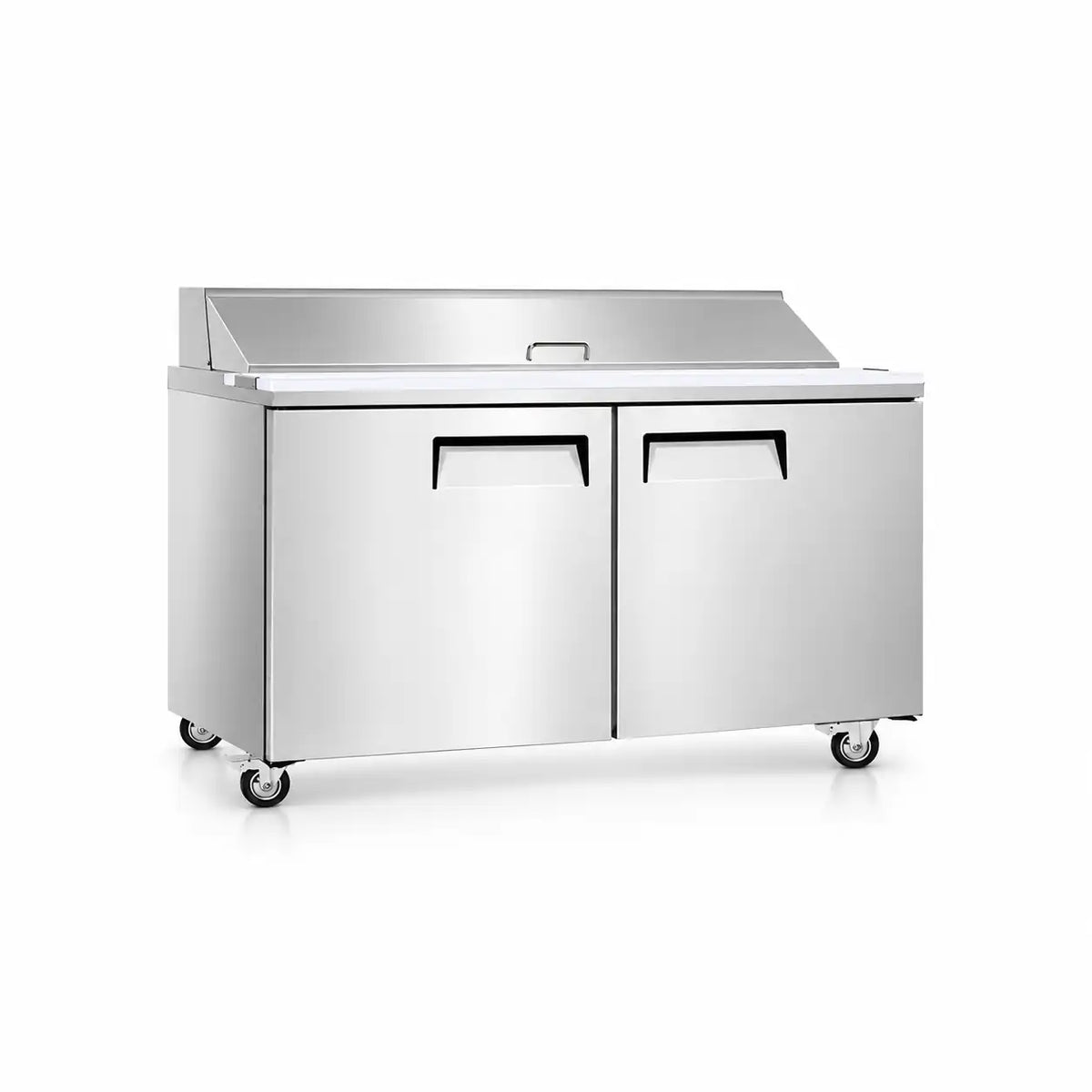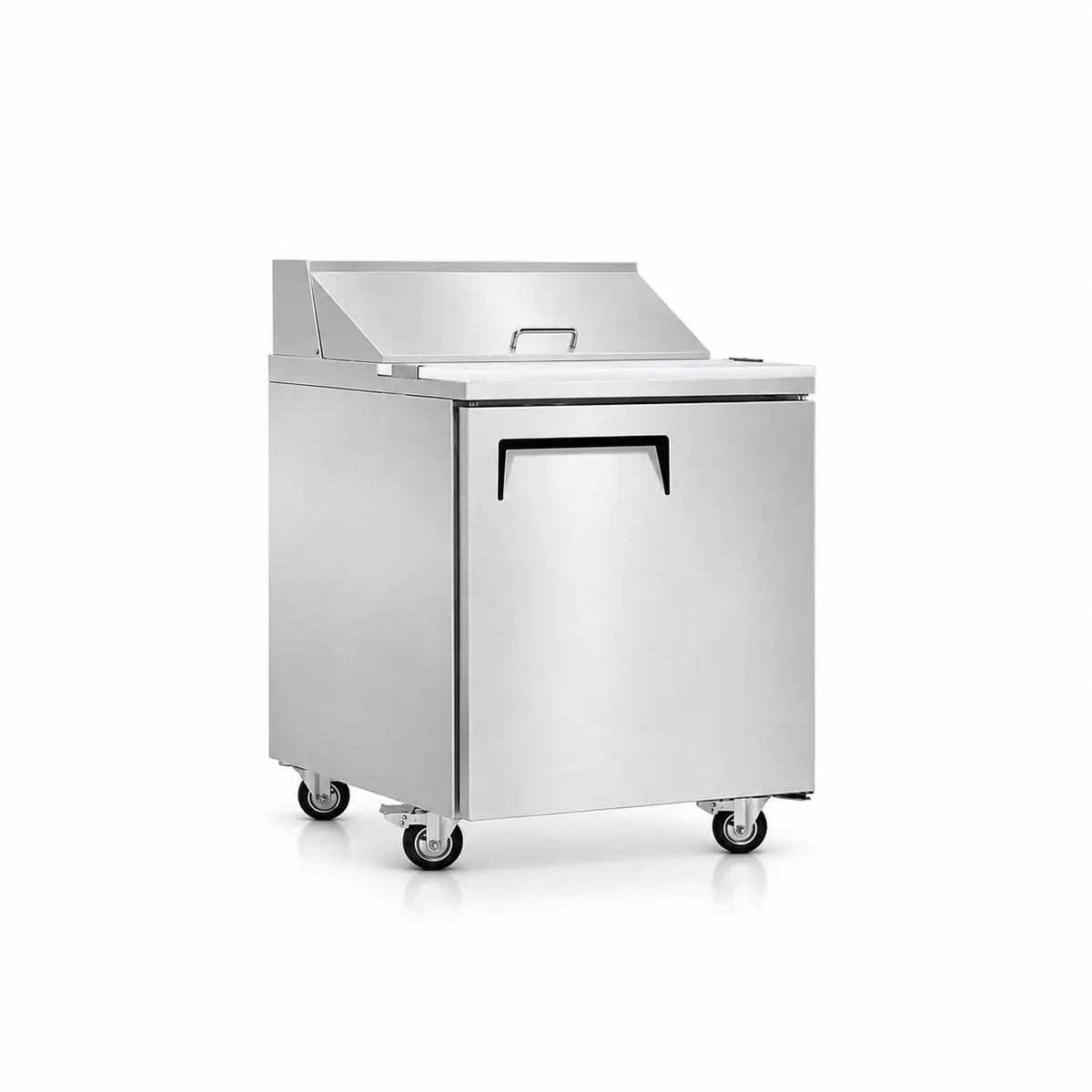
Sandwich Prep Table Buying Guide: Choose the Right Size and Layout

A sandwich prep table should fit the way your kitchen builds food: the ingredients staff reach for, the space they need to assemble an order, and the backup supplies they use during service. A larger cabinet or longer pan list does not necessarily solve the problem.
Use this guide to work from menu to pan layout, then to cutting board space, base storage, and installation. By the end, you should have a short list of requirements you can use to compare equipment.
Do You Need a Refrigerated Sandwich Prep Table?
A commercial sandwich prep table makes sense when staff repeatedly assemble sandwiches, wraps, salads, or other cold dishes using several refrigerated ingredients. Delis, sandwich shops, cafés, and quick-service kitchens may benefit from having those ingredients together at one station.
Look at what happens during a busy service. Does the person assembling orders repeatedly leave the station for cheese, vegetables, or backup containers? Are several ingredients needed within reach throughout service? Those are useful reasons to consider a dedicated refrigerated prep station.
If cold food is a small part of your menu, your existing refrigerator and a separate worktable may already meet your needs. A refrigerated countertop ingredient station may also be worth evaluating where suitable worktop and backup storage already exist. Compare the complete setup, including food holding and cleaning, before adding another appliance.
Sandwich Prep Table vs. Pizza Prep Table
Both types combine ingredient access with refrigeration, but the work surface often determines which is more suitable. Sandwich and salad preparation typically involves assembling individual portions from several ingredients. Pizza preparation needs room for the whole pizza, its tray or screen, and the movements involved in topping it.
| Compare | Sandwich / salad prep table | Pizza prep table |
|---|---|---|
| Typical task | Building sandwiches, wraps, and salads | Assembling and topping pizzas |
| Work surface | Often a shallower cutting board | Usually a deeper preparation surface |
| Ingredient layout | Commonly configured around smaller topping pans | Often accommodates larger topping pans and a raised rail |
| Practical fit check | Your largest sandwich, bowl, or wrap setup | Your largest pizza and working tray |
These are common design patterns, not universal specifications. Check the actual board dimensions, pan configuration, and base storage of each model. A kitchen serving both sandwiches and pizza should test its largest assembly task rather than assume one table will handle everything comfortably.
Standard Top vs. Mega Top: Which Problem Are You Solving?
A mega top expands the ingredient area to accommodate more pans than a comparable standard-top arrangement. It is worth considering when your regular menu needs more ingredients open at the same time. It is less useful when the real shortage is room to assemble or pack an order.
| What happens during service? | What to prioritize |
|---|---|
| Staff repeatedly exchange pans to offer the regular topping selection. | Compare expanded rail layouts, including mega tops. |
| All ingredients fit, but finished food crowds the board. | Prioritize usable board dimensions or a separate packing surface. |
| One popular ingredient runs out while other pans remain nearly full. | Consider a compatible larger pan or a better refill arrangement before adding positions. |
| Rear ingredients are difficult to reach. | Test rail depth and layout; adding another row may make access harder. |
Compare actual dimensions. Manufacturers use different board depths and cabinet designs, so a mega top does not always have the same spatial trade-offs. The name also tells you nothing by itself about base capacity or refrigeration performance.
Plan Your Ingredient Pans: A Café Example
Pan count is not a complete capacity measurement. A “12-pan” layout may contain different pan sizes, and the count alone says nothing about approved depth or ingredient volume.
Start by listing ingredients used simultaneously, rather than counting menu items. The following is an illustrative planning exercise, not a tested layout or a specification for a particular product.
Turn three menu items into one ingredient list
Imagine a café serving a turkey sandwich, a chicken wrap, and a vegetarian salad. Together, the recipes use cooked turkey, cooked chicken, lettuce, tomato, cucumber, cheese, and two chilled sauces: eight distinct refrigerated ingredients. Lettuce used in all three dishes still belongs on the shared ingredient list once.
| Ingredient group | Planning decision | Effect on equipment selection |
|---|---|---|
| Turkey and chicken | Allocate separate containers according to use between refills. | Allow for two ingredient positions and accessible backup stock. |
| Lettuce | Assess the volume needed across all three dishes. | A larger compatible pan may be more useful than another small position. |
| Tomato, cucumber, and cheese | Keep each accessible in a size that matches turnover. | Evaluate the combined rail footprint, not just the number of openings. |
| Two chilled sauces | Choose suitable containers and a dispensing method. | Include any adapters, lids, or bottle storage needed. |
This café should compare layouts that accommodate those eight ingredients in appropriate containers. It cannot conclude that any eight-pan table will work: one larger pan may occupy several smaller positions, and not every rail accepts the same arrangement.
Use refills to identify the real capacity need
For each ingredient, estimate the amount needed between practical replenishment breaks. Then identify the approved pan size and depth and where its replacement container will wait. Pan material, dividers, and depth must suit the exact table.
If lettuce is the only ingredient that needs frequent replenishment, changing that pan arrangement may address the shortage. If the café adds a build-your-own menu with several more simultaneous toppings, an expanded rail becomes a more relevant option.
Choose Between 36, 48, 60, and 72 Inches
Use common widths as a shortlist, then compare what each model actually provides. Nominal 36-, 48-, 60-, and 72-inch widths are approximately 914, 1,219, 1,524, and 1,829 mm. Actual cabinet measurements may differ.
The café in our example now has a clearer brief: room for eight ingredients in suitable containers, space to assemble its largest wrap, and somewhere to move the finished order. Its width choice depends on which configuration meets all three needs.
| When More Width Helps | When More Width Won’t Help |
|---|---|
| The required pan arrangement and assembly area cannot fit together. | The shortage comes from an unnecessarily large pan allocation. |
| Two operators need distinct working zones and a layout trial shows adequate room. | They still compete for the same ingredients or block each other's storage access. |
| The longer model provides the usable base storage you need. | Your backup containers do not fit its shelves or openings. |
| You need more board length for assembly and handoff. | The board remains too shallow for the bowl, wrap, or tray. |
Test the cutting board before choosing the cabinet
Mark the proposed board's length and front-to-back depth on a work surface. Build your largest order there, including its bowl or tray. Add the movement needed to finish and hand off the food. If wrapping and packing happen at that station, include those steps too.
For our café, a layout that holds all eight ingredients but leaves no room to fold the wrap fails this test. More pan positions would not help. A deeper board, a longer working area, or a separate packing surface deserves attention first.
For a shared station, run the same exercise with both operators. Do not assign a daily order capacity or employee count from cabinet width alone.
Doors, Drawers, and Usable Backup Storage
Choose a door base when flexible shelf space suits your mix of containers, bottles, and backup pans. Drawers deserve consideration when compatible replacement pans form the core of your refill process. The better arrangement is the one that fits the supplies you actually use.
In the café example, a door base may suit a mixture of sauce containers and prepared ingredients. A drawer layout may be convenient if the team standardizes its backup pans. Compare internal dimensions, supported pan arrangements, load limits, and access before deciding.
Bring the measurements of your tallest container and largest backup pan to that comparison. Cubic feet alone will not show whether either fits through the opening or between shelves. Leave the manufacturer's airflow paths clear.
If bulk stock remains in a nearby reach-in, size the prep-table base around working backup supplies. Buying enough undercounter storage for everything can consume space the kitchen needs elsewhere.
Check Temperature, Installation, and Service Requirements
Separate food temperature from the display reading
Look for documented performance for both the ingredient rail and base under the intended operating conditions. The controller display cannot establish the temperature of every food item. Use a suitable calibrated thermometer to verify food temperatures during operation.
The 2022 FDA Food Code, Section 3-501.16, generally specifies cold holding at 41°F (5°C) or below for foods requiring temperature control for safety, with stated exceptions. It is a model code; follow the rules and procedures applicable to your location.
For equipment selection, the practical questions are the permitted kitchen temperature, pan loading, lid-use requirements, and nearby heat sources. Refrigerant type or compressor horsepower alone does not answer them.
Measure the complete installation
Check full cabinet dimensions, lid-open height, door or drawer travel, ventilation clearances, and service access. Include the route through entrances and kitchen aisles. Front-breathing equipment still needs the installation conditions specified in its manual.
Verify voltage, frequency, phase, amperage, plug, and circuit requirements for the exact model. Identify how the condenser, gaskets, and other service items can be reached without dismantling your line.
Check certification and support
Verify sanitation and electrical safety listings separately. Intertek explains that its ETL Sanitation Mark relates to applicable sanitation standards; a general reference to “ETL” is not enough to identify every certification a product carries. Match documentation to the exact model and your jurisdiction's requirements.
Read the warranty terms, including labor coverage, service arrangements, and exclusions. Check availability of replacement boards, gaskets, and pan supports before purchase.
Turn Your Requirements Into a Shortlist
Before comparing prices, write a short requirement list. For our illustrative café, it would describe the eight-ingredient layout, the largest wrap assembly task, the chosen backup containers, and the available installation space. Your own list should cover:
- The rail layout accommodates the ingredients needed simultaneously.
- Pan sizes, depths, materials, and divider arrangements are compatible.
- The cutting board fits your largest assembly task.
- The base holds your actual backup containers.
- Staff can reach ingredients and move around the station comfortably.
- The unit fits the delivery route and installation space with required clearances.
- Electrical supply and circuit requirements are confirmed.
- Temperature specifications and operating conditions suit the kitchen.
- Certification documents, warranty terms, and replacement parts have been checked.
Use that list to compare sandwich and salad prep tables by configuration, working space, and storage. Eliminate models that fail a requirement before weighing price or optional features. For MagicoolUSA purchases, confirm your address is within the Los Angeles delivery service area.
Frequently Asked Questions
Can I change the ingredient pan layout?
Sometimes. Alternative pan sizes may be supported with compatible divider bars, but the opening dimensions, pan depth, material, lid clearance, and refrigeration design can limit the arrangement. Ask for an approved layout for the exact model rather than assuming all food pans are interchangeable.
Should I buy extra capacity for a future menu?
Allow for a specific planned change, such as additional toppings or a second assembly task. Empty pan positions alone do not establish useful future capacity. Consider whether the rail, work surface, backup storage, and kitchen footprint would still suit the expanded menu.
Can ingredients stay in the top rail overnight?
Check the manufacturer's operating instructions and your food-storage procedures. Do not assume closing the lid makes every rail suitable for overnight storage. Where food must be moved to covered refrigerated storage, include that capacity and handling step in your plan.
Can a prep table cool freshly cooked ingredients?
Do not assume equipment designed for cold holding is suitable for cooling hot food. Use an approved cooling process and equipment appropriate to the task. Confirm loading requirements in the prep table's manual, and arrange for ingredients to reach the required temperature before they enter the service rail.