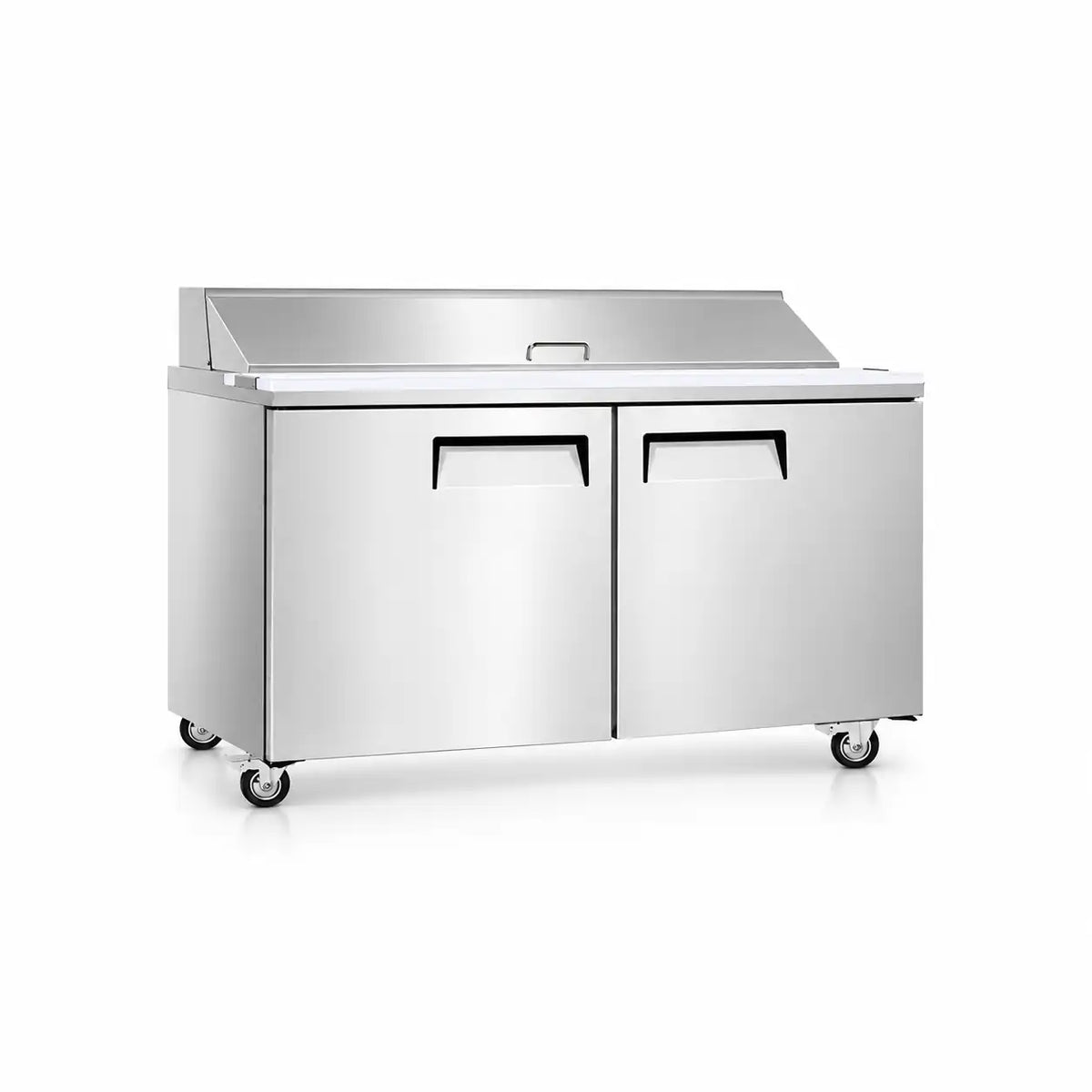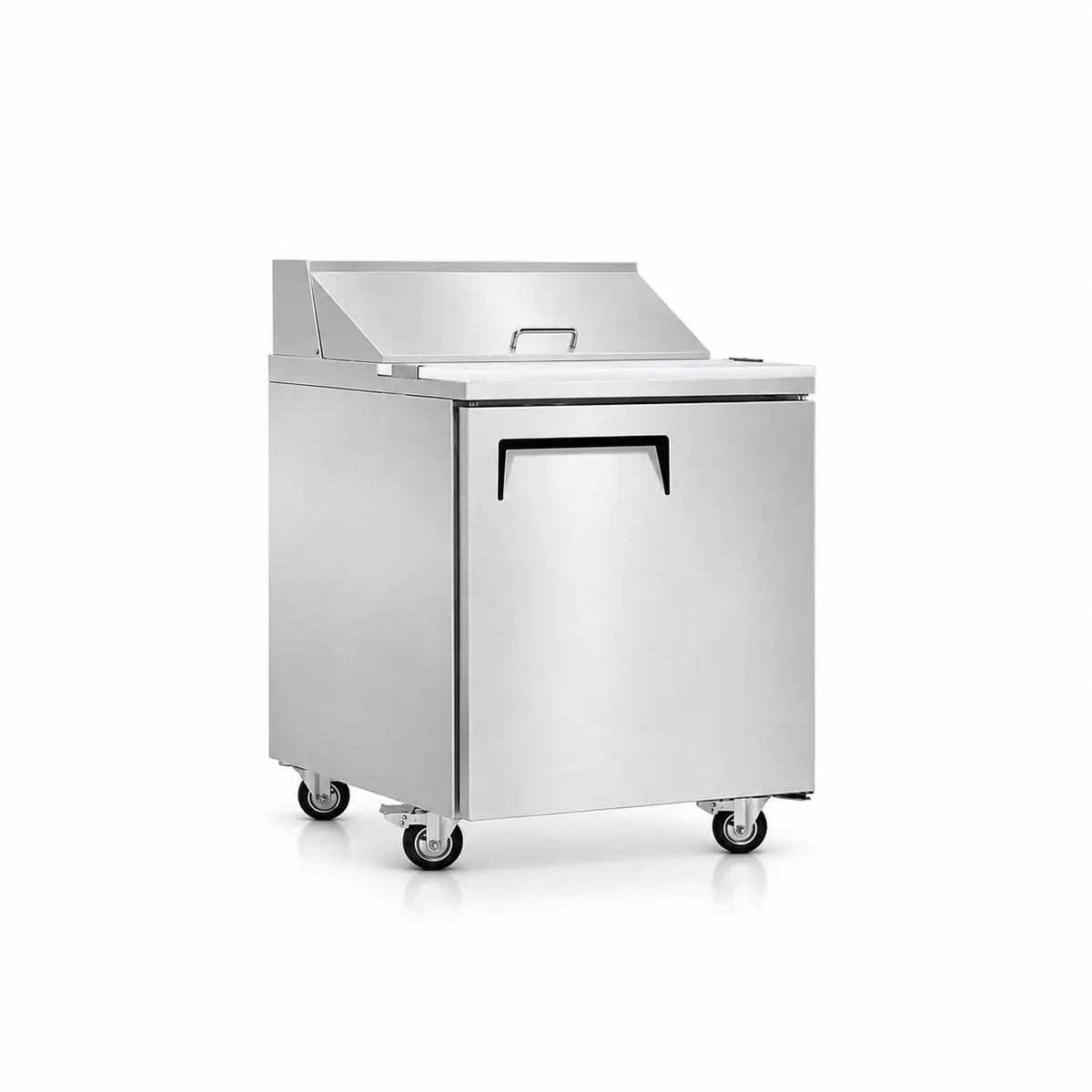
Standard vs. Mega Top Prep Tables: Which Fits Your Menu and Workspace?

A refrigerated sandwich or salad prep table is more than cold storage. It is a working station that affects how quickly employees reach ingredients, assemble orders, replenish pans, and move through the kitchen.
Choosing between a standard top and a mega top should not start with “Which one is bigger?” A better question is: Does your menu actually need the extra ingredient capacity of a mega top?
Standard Top vs. Mega Top at a Glance
| Consideration | Standard Top | Mega Top |
|---|---|---|
| Ingredient access | Moderate | Higher |
| Typical layout | Fewer top pans | More top pans |
| Best fit | Focused menus | Ingredient-heavy menus |
| Workspace | Often easier to manage | More area dedicated to ingredients |
| Kitchen fit | Often easier in tight spaces | May require more depth |
| Typical uses | Sandwich shops, cafés | Salad concepts, delis, build-your-own menus |
Standard Top vs. Mega Top: Compare the Options
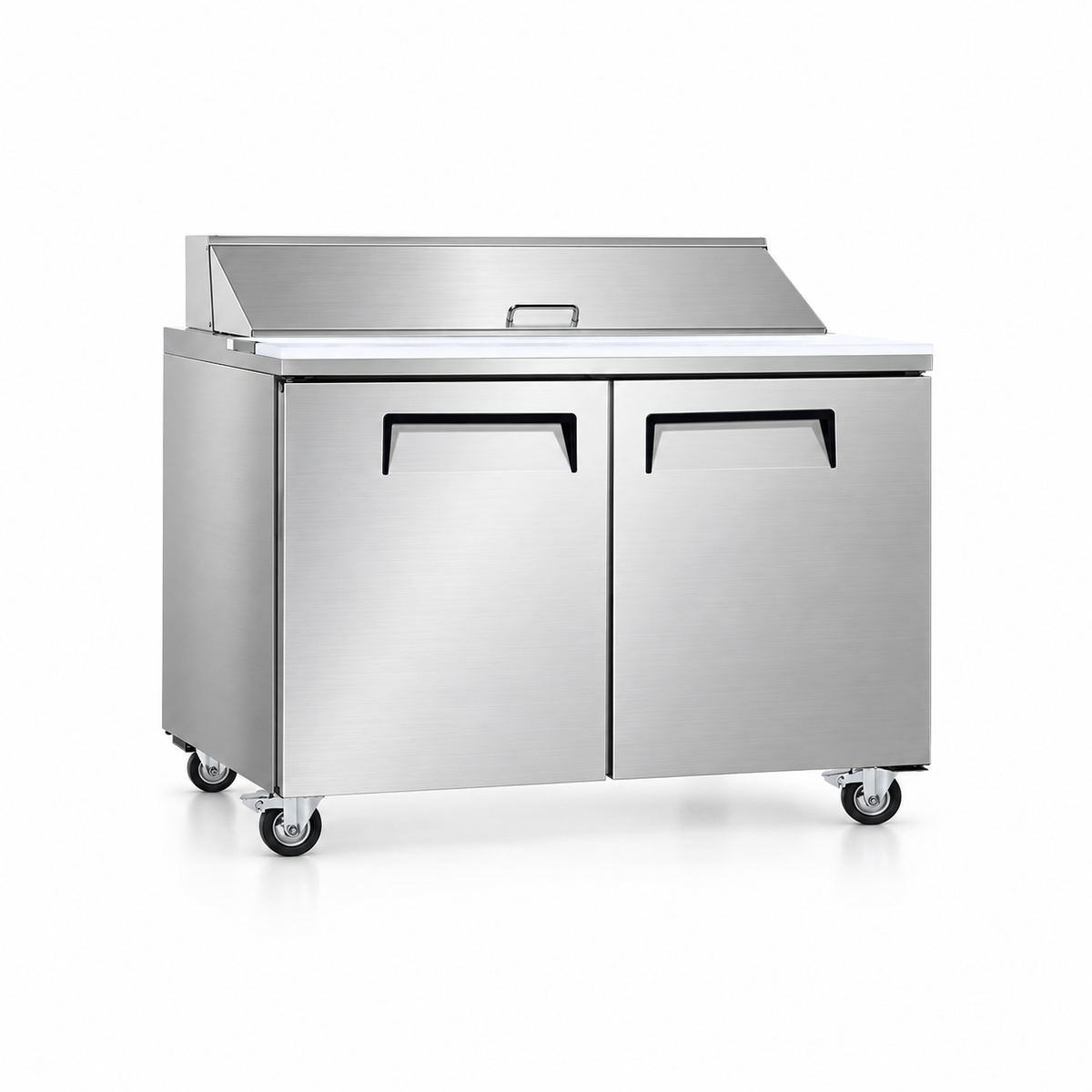
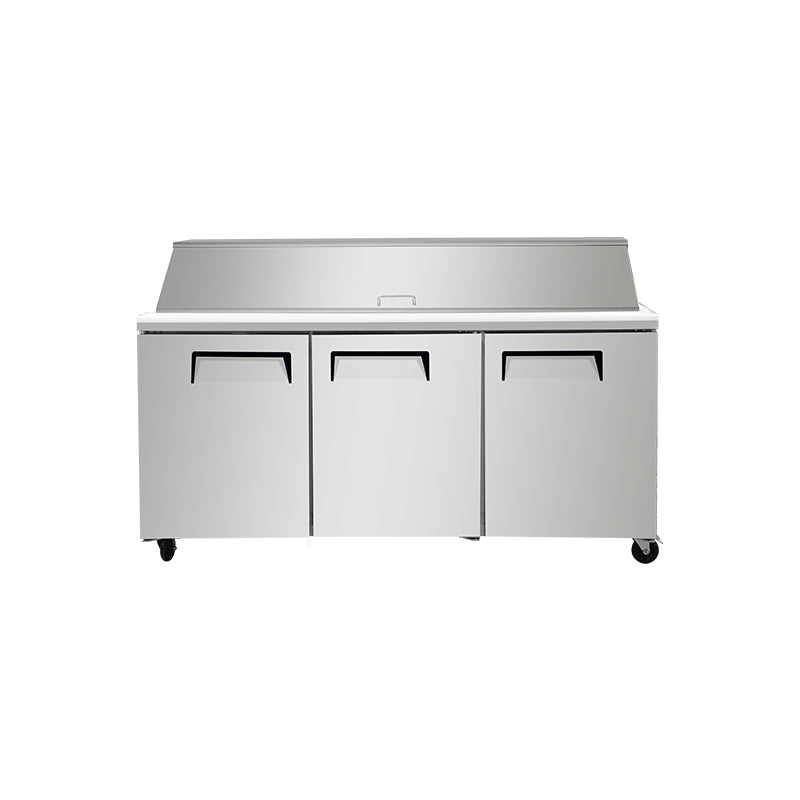
 Standard Top
- Fits 18 × 1/6-Size Pans
- 19.8 Cu. Ft. Refrigerated Storage
- Built-In Cutting Board
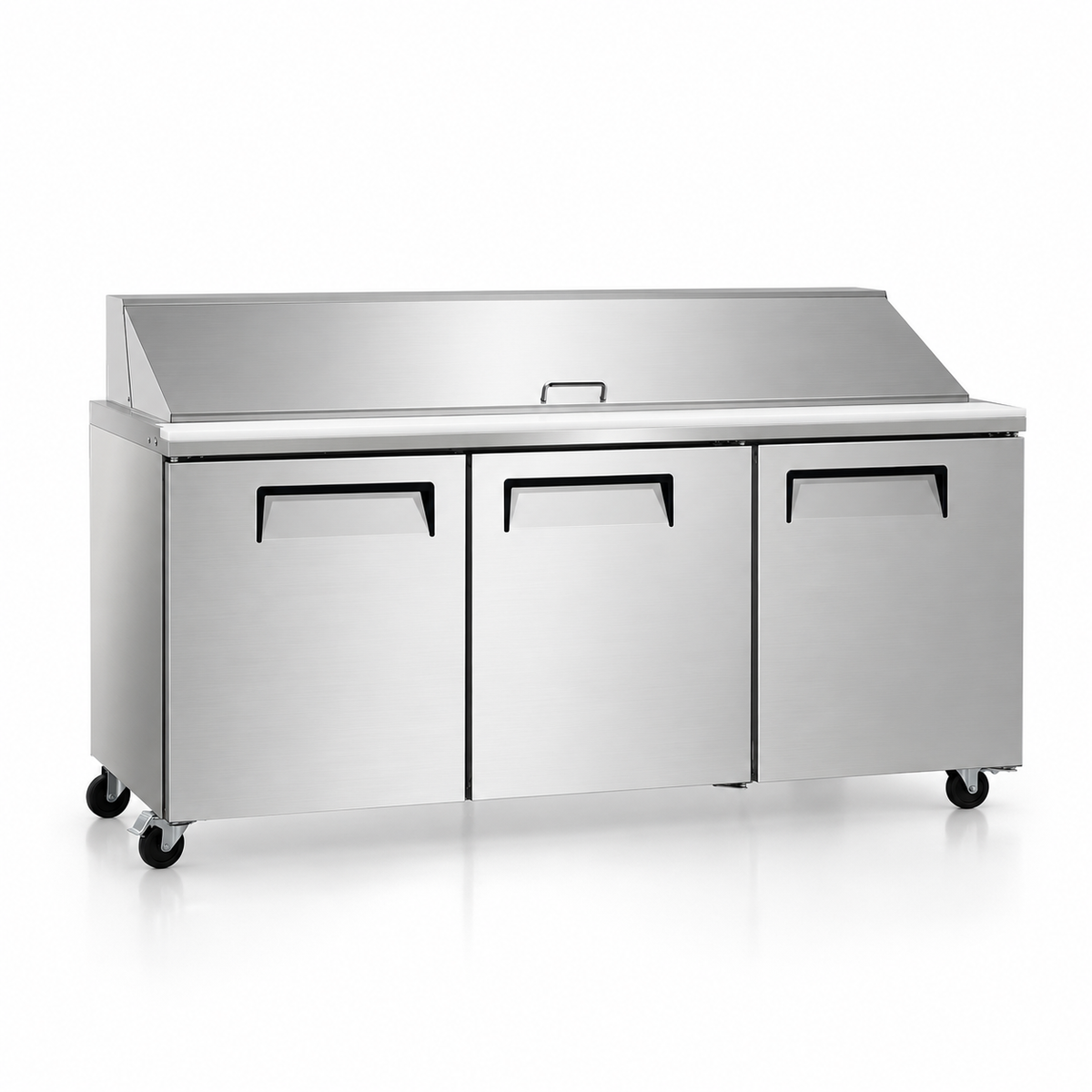
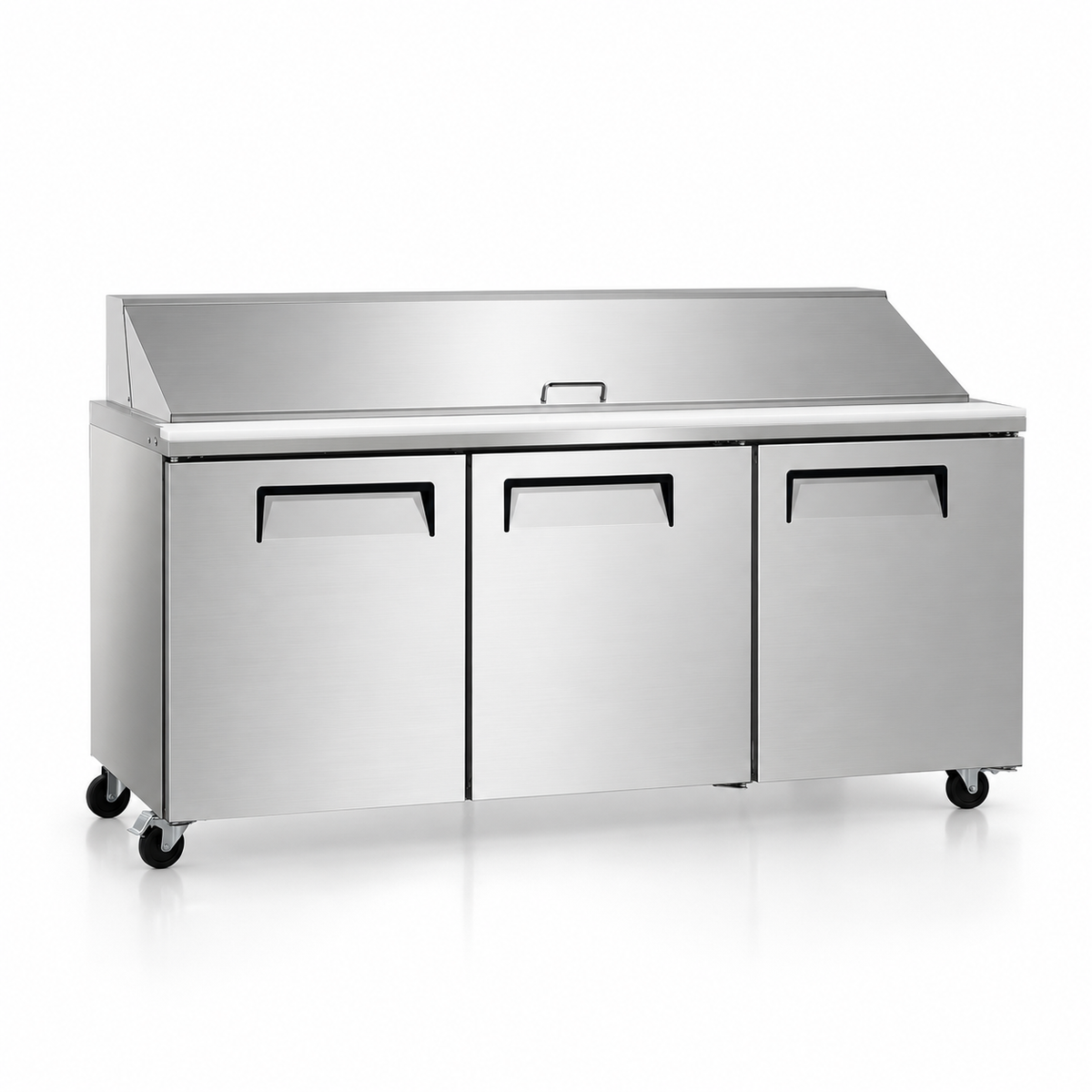
 Mega Top
- Fits 30 × 1/6-Size Pans
- 19.8 Cu. Ft. Refrigerated Storage
- Built-In Cutting Board
Standard Top vs. Mega Top: Pros and Cons
Both formats can work well. The better choice depends on how many ingredients must stay within immediate reach, how often pans need refilling, and how much workspace your kitchen can dedicate to the top rail.

Best for focused menus
SLSP72 Standard Top
Consider for: sandwich shops, cafés, and kitchens using a focused group of shared ingredients.
PROS
- Fits 18 × 1/6-size pans for organized ingredient access.
- Balances refrigerated ingredient capacity with practical prep space.
- Often easier to manage when the menu shares a core set of ingredients.
CONS
- Fewer ingredients remain within immediate reach during service.
- May require more pan changes as menu variety grows.
- Less suitable for highly customized, topping-heavy menus.

Best for more ingredient variety
SLSP72M Mega Top
Consider for: salad concepts, delis, and build-your-own menus that need more ingredients at the workstation.
PROS
- Fits 30 × 1/6-size pans for broader ingredient variety.
- Keeps more toppings, proteins, cheeses, or garnishes within reach.
- Can reduce repeated movement during busy, highly customized service.
CONS
- Extra pan positions add little value if they are rarely used.
- More pans and dividers can increase daily cleaning and organization work.
- The larger top layout may require more kitchen depth, depending on the model.
Both models provide 19.8 cu. ft. of refrigerated storage and a built-in cutting board. Always verify the current product specifications, clearances, and pan configuration before ordering.
Does Your Menu Actually Need a Mega Top?
Ask how many ingredients employees must reach without leaving the station during the busiest part of service. Do not count every ingredient stored in the restaurant. Count what must be immediately available during a rush.
A sandwich shop may sell 20 sandwiches that share the same core ingredients. Even with many menu items, the working ingredient set may remain simple, and a standard top may be enough. A build-your-own salad concept may require multiple greens, proteins, vegetables, cheeses, and garnishes at one station. In that case, extra top capacity can create real value.
Sort Ingredients Before Choosing Equipment
High-use
Used constantly across many orders. Give these priority in the top rail.
Medium-use
Used regularly but not in every order. They may stay above or below.
Low-use
Specialty or occasional ingredients do not always need a permanent pan.
The goal is not to put every ingredient in the rail. It is to keep the right ingredients within reach.
What Is a Standard Top Prep Table?
A standard top combines refrigerated storage below, ingredient pans above, and a cutting or assembly surface. Fewer top-pan positions can support a cleaner, more organized workstation.
Standard top often makes sense when many dishes share ingredients, employees rarely leave the station for toppings, front-to-back space is limited, and cutting or assembly space is especially important.
What Is a Mega Top Prep Table?
A mega top provides more refrigerated ingredient capacity at the top of the unit. Its value comes from keeping more ingredients within immediate reach and reducing repeated movement.
It is especially relevant for salad concepts, build-your-own menus, delis with many meats and cheeses, and sandwich operations with extensive customization. If employees repeatedly turn around, open another refrigerator, retrieve an ingredient, and return, those steps add up over a shift.
Will a Mega Top Actually Make the Line Faster?
Observe the station during a busy period. Do employees frequently leave, open the lower cabinet every few orders, walk to another refrigerator, swap pans, or interrupt assembly because an ingredient is not nearby?
If yes, additional top capacity may improve workflow. If employees already follow a smooth reach → assemble → serve → replenish sequence, a larger rail may add little value.
Think About Refill Frequency, Not Just Pan Count
Sometimes the problem is not a lack of pan positions. High-volume ingredients may simply be stored in pans that are too small. If lettuce, chicken, or cheese repeatedly runs out, adding low-use pan positions may not solve the problem.
Track which ingredients empty first, how often they are refilled, whether they need larger usable capacity, and whether backup pans are easy to reach.
Pan Count Does Not Equal Usable Capacity
Consider pan size, depth, orientation, divider configuration, and ingredient consumption. One high-volume ingredient may need more capacity than several low-volume toppings combined. A rail can contain many pans and still be inefficient if its busiest ingredients require constant refilling.
Do Not Trade Away the Workspace You Need
The assembly surface may be used for opening bread, building sandwiches, preparing salads, wrapping food, staging takeout containers, or finishing several orders at once.
Check Depth, Not Just Width
Buyers often say, “I have room for a 48-inch prep table.” Width alone does not determine fit. Check overall depth and height, remaining aisle clearance, door swings, adjacent equipment, cleaning access, delivery path, doorways, and hallways.
A unit that technically fits against the wall can still create a poor layout if it narrows the aisle too much.
Make Sure the Kitchen Still Works After Installation
Employees should still be able to pass each other, doors or drawers should open fully, carts should move through the aisle, nearby equipment should remain accessible, and staff should be able to clean around the unit.
Consider Where Your Menu Is Going
Choose for today while considering realistic near-term changes. If menu expansion is planned within 6 to 12 months, leaving room for growth can make sense. If expansion is only a vague possibility, do not automatically sacrifice workspace or budget for capacity that may never be used.
More Capacity Can Mean More Cleaning
Extra pan positions can create more pans to wash, dividers to remove, edges to wipe, ingredients to label and rotate, and items to organize at closing. If the extra pans are actively used, the trade-off may be worthwhile. If they remain empty, they add maintenance without improving service.
Standard vs. Mega Top by Restaurant Type
| Restaurant Type | Typical Starting Point |
|---|---|
| Focused sandwich shop | Standard |
| Café with limited food menu | Standard |
| Traditional deli | Standard or depends |
| Deli with many toppings | Mega or depends |
| Salad shop | Mega |
| Build-your-own concept | Mega |
| Small kitchen with tight aisles | Measure first |
Restaurant type is only a starting point. Actual ingredient count and workflow matter more than the restaurant label.
What Can Go Wrong?
Unused mega capacity
You pay for extra pans that provide little benefit.
Standard is too limited
Employees repeatedly leave the station or swap pans.
The aisle is blocked
The width fits, but the equipment depth creates a poor layout.
Pan count drives the choice
The sizes do not match how ingredients are actually used.
Standard or Mega? Use This 60-Second Check
Consider Mega Top if…
- the menu uses many toppings;
- orders are highly customized;
- employees often leave the station;
- pans are swapped during rushes;
- one station handles several categories;
- extra capacity would reduce movement;
- the kitchen has enough clearance.
Consider Standard Top if…
- the menu is focused;
- many dishes share ingredients;
- employees rarely leave for toppings;
- some ingredients are occasional;
- assembly space is important;
- the kitchen is tight;
- extra pans would remain unused.
If the answer is unclear, observe one busy service period for 30 to 60 minutes. Record which ingredients are used most, which pans empty first, how often employees leave, what causes delays, and how much workspace they use.
Before You Buy, Compare the Exact Model
- Exterior width, depth, and height
- Pan quantity, size, layout, and depth
- Cutting-board dimensions
- Refrigerated storage below
- Door or drawer configuration
- Electrical requirements
- Delivery and working clearance
Final Decision
A standard top is often better when the menu is focused, dishes share ingredients, and the kitchen values practical prep space. A mega top becomes useful when the operation relies on many toppings, frequent customization, and fast access to many ingredients.
The best prep table is not the one with the most pans. It is the one that reduces unnecessary movement, supports the menu you actually serve, and fits naturally into the way your kitchen operates.